
The Markt empties not long after nine, and once the café chairs are stacked and the fountain is the loudest thing in the square, the Rococo front of the old town hall stops being a photograph and becomes a wall: pale, tall, lit from below, with the dark of the lanes behind it. The night watchman's round is built for exactly that hour. Four of them leave Bonn's centre after dark, each with a man in a cloak carrying either a lantern or a live flame, and they are nothing like interchangeable.
What the night watchman actually was
Before municipal police forces and gas light, German towns hired men to walk the streets between dusk and dawn. The job was mundane and essential: call the hours so sleepers knew the night was being kept, watch for fire in a city built largely of timber and thatch, check that the gates stayed shut, move drunks along, and raise the alarm if anything worse was happening. The horn was a signalling instrument, not a prop. The halberd was for dogs and for the kind of argument that starts at two in the morning. The lantern was the whole of the watchman's authority made visible: if you could see him coming, he was doing his job.
The office died across the nineteenth century, outmoded by street lighting and a paid constabulary, and came back a hundred years later as a way of telling a city at night. That is worth saying plainly, because the format is sometimes sold as living history and it is not. It is a staged round, and the good versions know it. The costume buys the guide permission to talk about plague, punishment, fire regulations and the price of a funeral in a way a daytime walk cannot.
Bonn complicates it. This was a Roman garrison first, then for centuries the residence city of the archbishop-electors, who rebuilt it in the taste of their own age rather than preserving anyone else's. The siege of 1689 flattened a great deal. The air raid of 18 October 1944 took most of what was left of the historic core. So Bonn does not hand you street after street of leaning half-timber, and any guide who implies otherwise is selling you a different town. What Bonn gives you instead is fragments at close range: a reconstructed gate, a Romanesque church that has outlasted everything around it, the electors' architecture standing where the medieval wall used to run. The rest the guide has to rebuild with voice. On a good night that works better than you expect, because you are standing in the actual dark, in the actual street, listening to someone explain what was once two metres above your head.
The round that runs in English
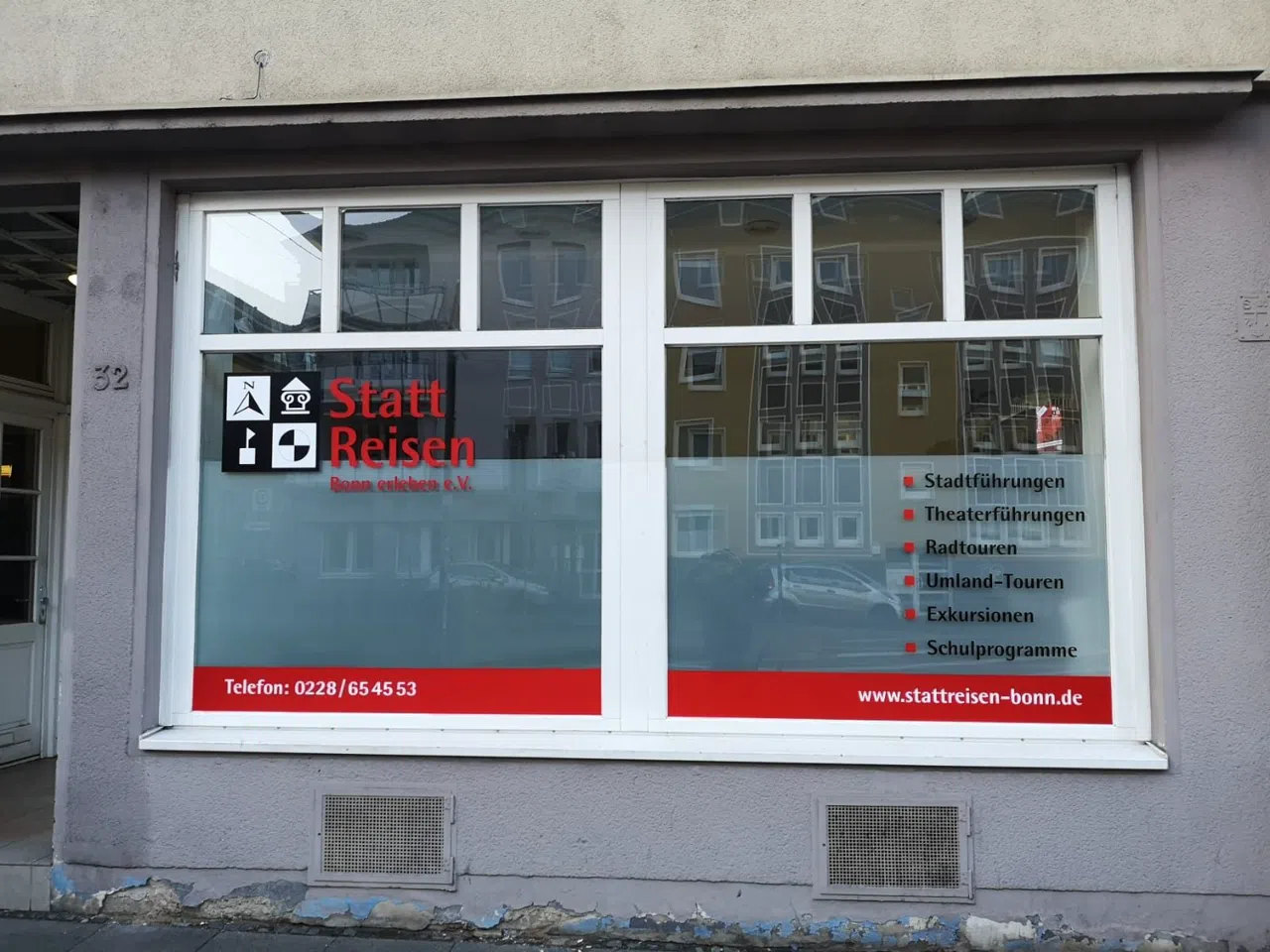
StattReisen Bonn (city-centre departures, meeting point confirmed on registration) is the one to book if your German is thin or absent. Its Mit dem Nachtwächter durch Bonn is the only Bonn watchman round scheduled as an English-language product rather than offered as a favour, and the operator has about thirty years of city-walk history behind it. Dates run from spring through December 2026.
Tickets are €14, or €12 reduced. One procedural trap is worth knowing. StattReisen's open Saturday walks generally take walk-ups, and this tour is the exception: advance registration is required, and you cannot turn up at the meeting point on the night and pay cash. Register. People get this wrong because they have read about the operator's other walks.
For groups, a private round takes up to 20 people at €195, or €160 at the reduced rate, and parties up to 50 can be arranged on request. The group price is flat, which means it stops making sense below roughly thirteen or fourteen people and then becomes the cheapest way to move a large party through the old town after dark. There is also a version at €48 per head that ends in the Nachtwächter-Schmaus, a three-course dinner, with a minimum of fifteen. That is the obvious shape for a work group, a reunion or a birthday where you need the evening to continue somewhere seated rather than dissolve on a pavement at half past ten.
It suits anyone who wants the history delivered in a language they fully follow, mixed-nationality parties, and groups that need a confirmed booking with a named contact rather than an arrangement.
A live flame in front of the town hall
Stadtführungen im Rheinland (guiders GmbH), meeting on the Markt in front of the old town hall, runs the Nachtwächterführung mit Fackel, the torchlit version. It is confirmed for 4 July to 19 December 2026, departing at 21:00, and it is German only.
The start is the reason to choose it. You gather on the Markt, the guide lights a real torch, and the first thing the flame does is throw moving light onto the eighteenth-century façade of the town hall, which was never designed to be seen that way and takes it very well. If anyone in your party is going to take one photograph of the evening, it happens in the first three minutes.
About €15 a head. Public dates carry a ten-person minimum, so a couple booking two seats on a quiet December Friday should understand the walk may not reach its threshold. Ask the operator how the date is filling rather than assuming. Private group bookings are standard, and this is where the tour is strongest: the Markt absorbs a party of thirty without anyone having to stand in a doorway, and starting in an open square rather than a narrow lane means the briefing is actually audible. If your group has no German speakers, this is the wrong round. The language is not negotiable.
The darker telling
van Üüm Events (central Bonn, meeting point given at booking) runs the Nachtwächter-Fackeltour as the grimmest of the Bonn four. Plague, witch trials, the executioner and what he was paid for each piece of work. Torches again, and the guide sings the watchman's call, Hört ihr Leute, lasst euch sagen, rather than reciting it, a small thing that changes the temperature of a dark street considerably.
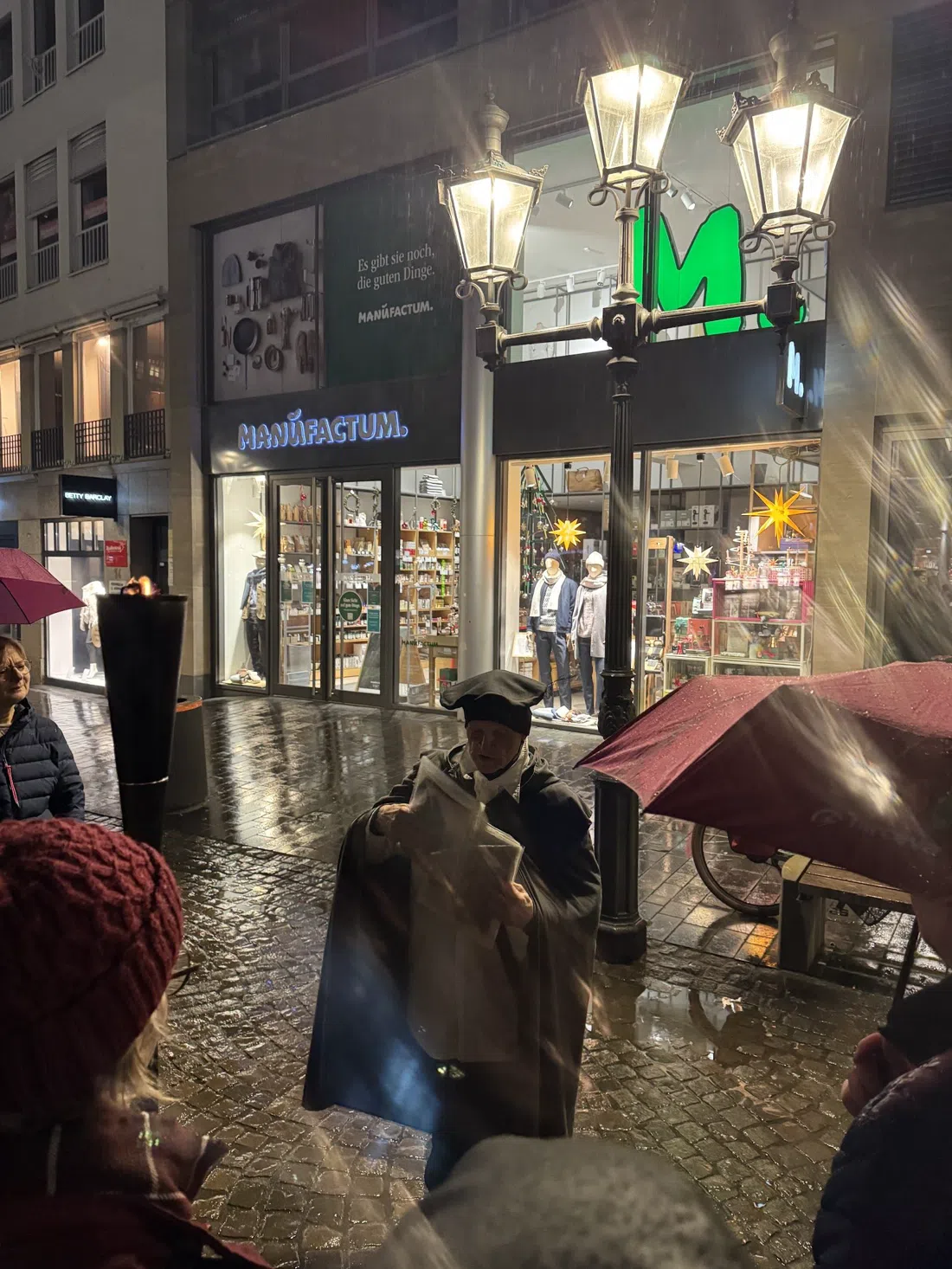
It runs about an hour and forty-five minutes, the longest of the set, and the operator advises against children under twelve. Take that seriously. It is the operator's own line, not squeamishness imported by a guidebook, and the content earns it. Roughly €15 to €20 per person, with group rates on request. Group bookings are the core of the business (an events agency that also runs walks, not a guiding collective that occasionally takes a group), so expect a competent organiser on the other end of the email and a willingness to fit the walk into a longer evening.
It suits adults who actually want the dark material, stag and hen parties who would otherwise get restless on a gentler round, and anyone for whom the torch is the point. Not families with younger kids, and not anyone who wants a light, anecdotal hour.
The oldest lineage and why you should telephone first
Erlebnisstadtführungen Rheinschleier (Bottlerplatz and the lanes around the Münster) is the complicated one, and it needs stating honestly rather than tidied into a recommendation. This is the original Bonn night watchman's lineage, and the route is the most coherent of the four: from the Sterntor, the reconstructed gate standing on Bottlerplatz with its salvaged stretch of medieval wall, through to the pillory site at the Münster. In other words, from how the city kept people out to how it punished the people inside. On paper it is the walk you would design if you were designing one.
The difficulty is that the original watchman, Elisabeth Schleier's husband, has died, and there are no public dates left. What remains is group-only in practice: €10 a head for ten or more, or a flat €100 for a smaller party, with dates arranged directly by phone or email.
So telephone before you promise anybody a watchman. Do not book flights, dinner and twelve friends around an enquiry email. If it is running on your date it is the cheapest per-head round in the city and the best route. If it is not, you need one of the other three, and you want to know that two weeks out rather than two hours out.
The ground you cover
All four rounds work the same compact centre, and it is genuinely walkable. Nothing on any of these routes needs a car, and nothing worth seeing after dark in Bonn is out of reach on foot. Expect somewhere between ninety minutes and two hours, and a total distance a comfortable walker would cover in twenty minutes if nobody stopped to talk.
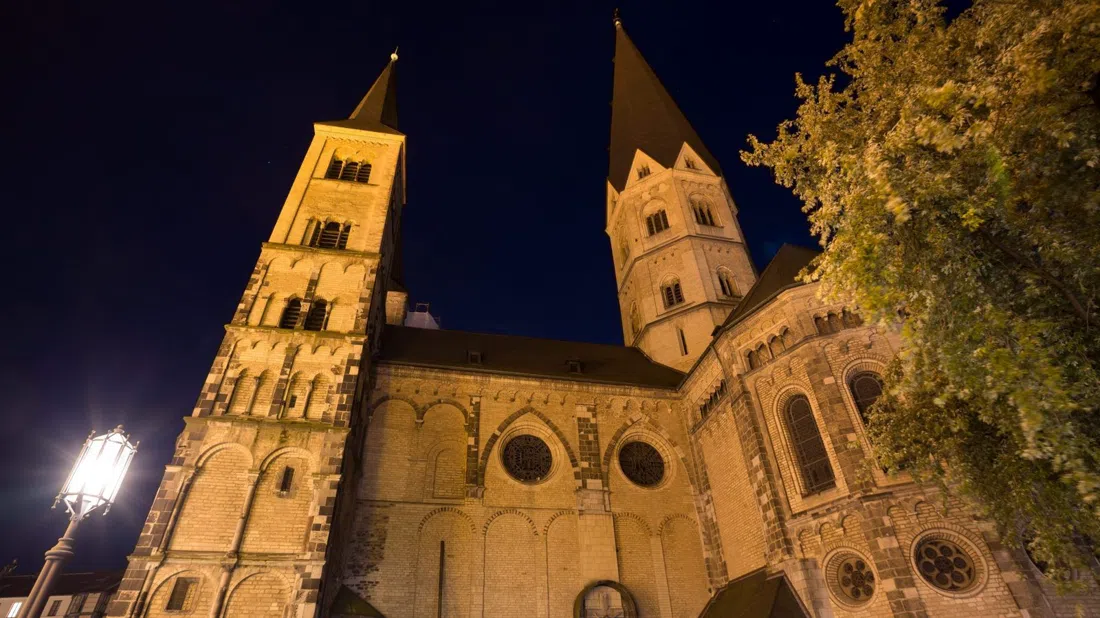
The spine is the Markt with the old town hall, built in the 1730s with the pink-and-grey theatricality of a court city; the lanes running off it (Sternstraße, Bonngasse, Rathausgasse, Brüdergasse), which hold the line of much older streets even where the buildings are post-war; Bottlerplatz and the Sterntor; and the Münster, whose Romanesque tower is the one thing in the centre that has watched the whole story happen. Münsterplatz in front of it is where the watchman's talk usually turns to crowds, proclamations and punishment, because that is what the square was for.
The compactness has a practical consequence. The walks are a reasonable proposition even in poor weather, because you are rarely more than five minutes from a bar, and the cobbles are the real hazard rather than the distance. Flat shoes with some grip. Bonn's old-town paving is uneven, wet most of the year, and dark on purpose.
Choosing between the four
If you do not speak German, the decision is made for you: StattReisen, booked in advance.
If you do, and you are a couple or a pair of friends, the honest reading is that per-seat availability is the constraint rather than quality. StattReisen's scheduled dates sell individual tickets outright. The torchlit round on the Markt sells seats but needs ten bodies to go. The darker tour and the original lineage are both built around group bookings, which means two people are negotiating for a slot rather than buying one.
If you are a group, work backwards from size. Up to twelve or so: ask about the flat €100 arrangement with Rheinschleier first, then the per-head options. Fifteen to twenty: the private StattReisen round at €195 is the better arithmetic, and the dinner version at €48 a head solves the whole evening in one booking. Thirty or more: the Markt start is the one that physically works, and the English-language operator will take parties up to 50 on request.
If you have children, ask the ages up front. Under twelve rules out the darkest round by the operator's own advice. The others are more forgiving, but none of these walks is designed for a six-year-old at ten at night.
Before you go
Departures cluster at 21:00, which in a German summer means you will spend the first half-hour in dusk rather than dark. For the full effect, real black between the lamps and the torch doing actual work, book from October onwards, when 21:00 is properly night. The advent weeks are atmospheric and busy in equal measure.
Register in advance for every one of these, without exception. Bonn's watchman rounds are not walk-up products, even where the same operator's daytime walks are. Give the operator your party's language and the ages of any children in the first email; it saves a refund later.
Carry cash. Several Rhineland guides still settle on the night, in notes, directly with the guide, and a German guiding operation is under no obligation to take your card on a pavement at nine in the evening.
The centre is pedestrianised and the Markt is five minutes from the Hauptbahnhof, so arrive by train or tram and skip parking entirely. Stadtbahn and bus services thin out noticeably after eleven, which is roughly when a 21:00 round finishes. Check the last connection before you start, or plan to stay central. If you want to be able to walk back to your room, look at the Bonn hotel search for the streets immediately around Münsterplatz and the Markt.
For budget, reckon €14 to €20 per person for a public date, €10 to €13 a head inside a group booking, €170 to €195 for a private round, and €48 if you want the three-course dinner attached. A watchman walk plus a drink afterwards is an evening for under €30 a head, which for Bonn is modest.
Wear layers, flat shoes, and something waterproof between October and March. You will stand still for five minutes at a time while someone talks, and standing still is what makes a Rhine valley night cold.
For what to do with the daylight either side of it, the Bonn guide covers the rest of the city.